Anaesthesia
How comfortable you are is a decision, and it is partly yours.
Four options, chosen against the procedure, your health and how you feel about being awake for it. This page explains how the choice is made and what the monitoring actually is.
01 · The four options
Local anaesthetic
Awake, numb, and driving yourself home
An injection that removes sensation from the surgical area. You are fully awake and aware, you will feel pressure and movement but not sharpness, and you can eat beforehand and drive afterwards.
Right for most single extractions, most single implants, biopsies and suture removal.
Nitrous oxide
Light inhalation sedation
Nitrous oxide and oxygen through a small nose piece. It takes the edge off, wears off within minutes of stopping, and does not need an escort or fasting.
Right for mild anxiety, shorter procedures, and for people who do not want to be sedated but do not want to be entirely present either.
Intravenous sedation
Deeply relaxed, and unlikely to remember it
Medication through a cannula, titrated to effect while you are continuously monitored. You breathe for yourself and respond to voice, and most people remember very little.
Right for difficult impacted teeth, multiple extractions, longer implant surgery, and for genuine dental anxiety. Requires fasting and an escort.
General anaesthesia
Fully asleep, with breathing supported
Delivered by an anaesthetist in a hospital or licensed surgical facility, with your airway protected and your breathing managed throughout.
Right for orthognathic surgery, major reconstruction, facial trauma, and for patients whose medical history makes office sedation unwise.
02 · ASA classification
How your medical history decides where the surgery happens
The American Society of Anesthesiologists physical status classification is the shorthand every anaesthetist uses. It is not a judgement; it is a description of physiological reserve, and it decides how much of one a procedure will ask for.
| Class | Describes | Typical setting |
|---|---|---|
| ASA I | A normally healthy patient | Office sedation entirely appropriate |
| ASA II | Mild systemic disease — controlled hypertension, well-controlled diabetes, a current smoker, pregnancy | Office sedation appropriate with planning |
| ASA III | Severe systemic disease that is not incapacitating — poorly controlled diabetes, COPD, morbid obesity, a stent over three months old | Case-by-case. Often better in a hospital setting |
| ASA IV | Severe systemic disease that is a constant threat to life | Hospital, with anaesthetic colleagues |
| ASA V | A moribund patient | Not an office population |
An emergency modifier "E" is added where the case cannot wait. We record the class in the consultation letter, so the referring practice can see the reasoning as well as the conclusion.
03 · Monitoring
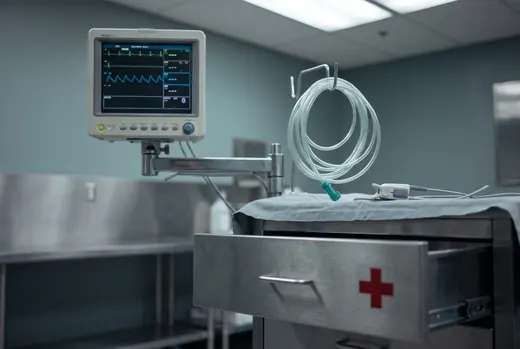
What is watched, and by whom.
Questions